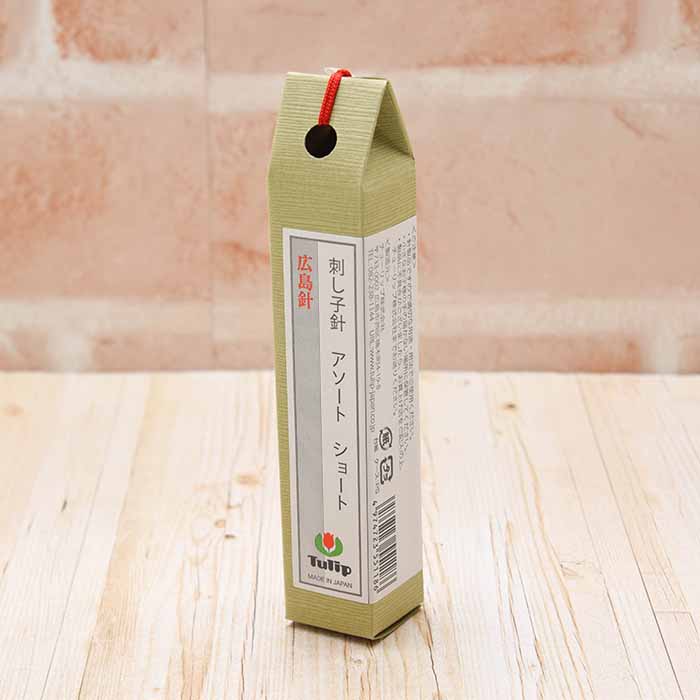
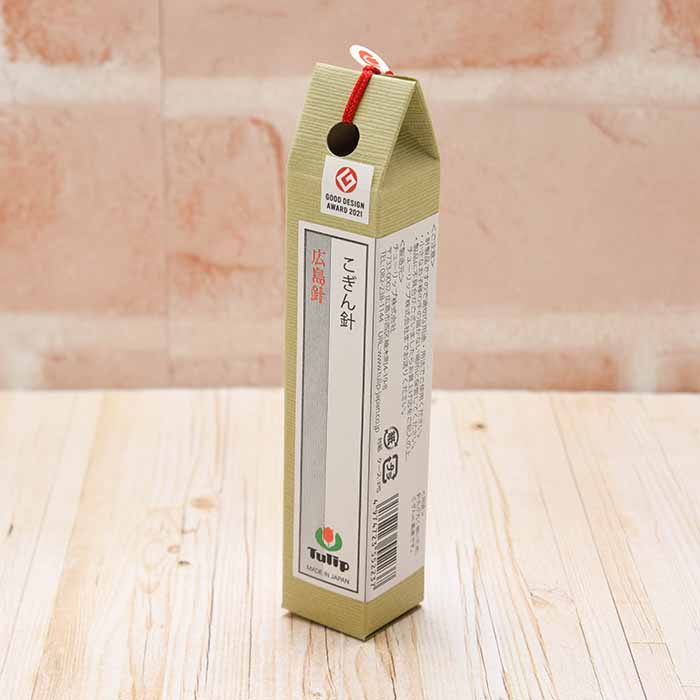
Clover Sewing Needles Gold Eye Needles 4 No.4
[Product Description]
Since its release in 1952, “Gold Eye Needles” have been loved by many as one of Japan’s representative sewing needles.
The pure gold plating on the eye (needle hole), which is also the origin of its name, takes advantage of gold’s softness to reduce friction with the thread and help prevent thread breakage.
This craftsmanship and the constant pursuit of high quality have supported its reliability for many years.
These Japanese needles are recommended for tasks requiring durability and smooth thread movement, such as futon making and repair or sewing thick padded cotton.
Hand sewing needles are broadly divided into two types: Japanese needles for traditional Japanese sewing and American-style needles for Western sewing.
Japanese needles are uniquely developed in Japan mainly for sewing kimono. They are hard, long, slender, and have sharp tips so that even delicate fabrics such as silk can be sewn smoothly without snagging. When sewing straight seams by hand without using a sewing machine, Japanese needles are suitable.
For Japanese needles, labels such as “3 No.4” and “3 No.3” are used. The first number indicates the thickness of the needle (a larger number means thinner), and the second number indicates the length (a larger number means longer).
As a general rule, use thicker needles for thick fabrics and thinner needles for thin fabrics.
When choosing a needle, the thickness should match the fabric, but beginners are recommended to start with two basic types: “long thick needles” and “short thin needles.”
≪Silk Needles≫
Main use: Silk fabrics, lightweight cotton fabrics
[Contents]
25 pieces
[Size]
Diameter 0.56mm / Length 42.4mm
[Materials]
steel (nickel-plated)
Country of origin: Japan
Product Information
Product Information
Shipping & Returns
Shipping & Returns
Description
[Product Description]
Since its release in 1952, “Gold Eye Needles” have been loved by many as one of Japan’s representative sewing needles.
The pure gold plating on the eye (needle hole), which is also the origin of its name, takes advantage of gold’s softness to reduce friction with the thread and help prevent thread breakage.
This craftsmanship and the constant pursuit of high quality have supported its reliability for many years.
These Japanese needles are recommended for tasks requiring durability and smooth thread movement, such as futon making and repair or sewing thick padded cotton.
Hand sewing needles are broadly divided into two types: Japanese needles for traditional Japanese sewing and American-style needles for Western sewing.
Japanese needles are uniquely developed in Japan mainly for sewing kimono. They are hard, long, slender, and have sharp tips so that even delicate fabrics such as silk can be sewn smoothly without snagging. When sewing straight seams by hand without using a sewing machine, Japanese needles are suitable.
For Japanese needles, labels such as “3 No.4” and “3 No.3” are used. The first number indicates the thickness of the needle (a larger number means thinner), and the second number indicates the length (a larger number means longer).
As a general rule, use thicker needles for thick fabrics and thinner needles for thin fabrics.
When choosing a needle, the thickness should match the fabric, but beginners are recommended to start with two basic types: “long thick needles” and “short thin needles.”
≪Silk Needles≫
Main use: Silk fabrics, lightweight cotton fabrics
[Contents]
25 pieces
[Size]
Diameter 0.56mm / Length 42.4mm
[Materials]
steel (nickel-plated)
Country of origin: Japan